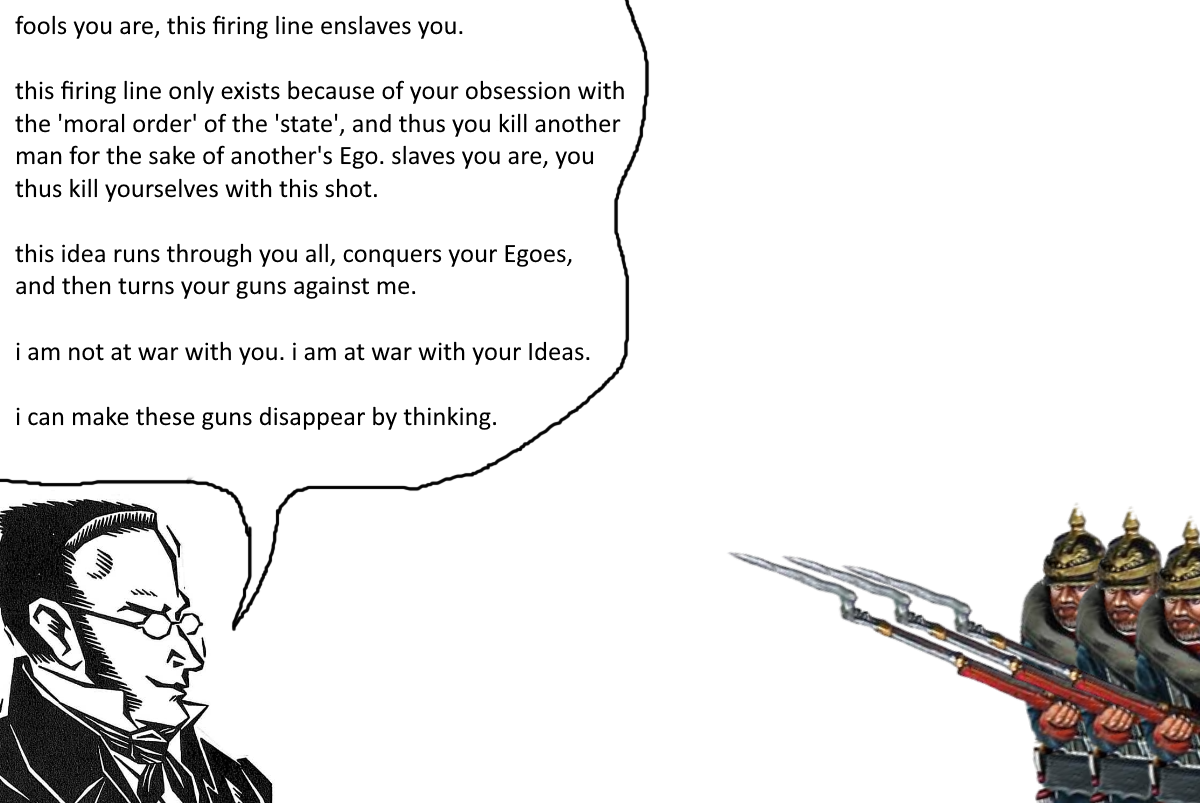
before we start this piece, i would like you to regard the introduction to this 1995 edition of “the ego and its own” i’m using, to properly get the scope of what’s being laid down.
Max Stirner’s The Ego and Its Own has been called ‘the most revolutionary [book] ever written’. First published in 1844, Stirner’s distinctive and powerful polemic sounded the death-knell of left Hegelianism, with its attack on Ludwig Feuerbach, Bruno Bauer, Moses Hess and others. It contains an enduring, and strikingly written, critique of both liberalism and socialism from the perspective of an extreme and eccentric individualism. Karl Marx was only one of many contemporaries provoked into a lengthy rebuttal of Stirner’s argument. More recently, Stirner has been variously portrayed as a nihilistic anarchist, a precursor of Nietzsche, a forerunner of existentialism, and as manifestly insane.
keep this radical nature in mind. this “most revolutionary book ever written” (per james huneker). keep this immediate presentation that we must, regardless of whether we agree or disagree, regard stirner as some kind of mad genius. that his ‘eccentric individualism’ has, on its own merits, meaningfully changed the scope of critical thought.
now, we are going to talk about the book. and i would like you to keep all that tucked away in your mind palace.
stirner starts with a standard critique that because god is a self-sustaining circular logic, god’s unity with moral Good means that service to god is service not to a cause perpetuated by god, but to god himself. and as such, service to religious Goodness is an egoistic cause for god.
but because, stirner astutely accepts, god doesn’t fucking exist, or if he does we can’t talk to him so what’s the point, humanity is actually serving its own cause. this is why god’s children don’t actually fucking love him, they’re using him as a head on a stick to justify themselves. the human cause is egoistic.
the human cause, itself, only exists by demanding people aspire to it. and it burns through all these people, and destroys them, and demands their service. and all that’s left is the idea, this fake ego, and all the nations, these things that demand service of us, they’re killing us for their perpetuation.
if you look at the people running these fucking things, stirner says, they only love you inasmuch as you are theirs. they love their people, but they don’t love their people when the people live for themselves, and defy the laws that make them theirs.
all of this nonsense, stirner says.
all of this fucking nonsense.
why shouldn’t i just live for myself? what’s real to me? why ought i serve this font of deceptions, just as real to me as god–that is, not real at all, just abstractions i am compelled to service with, by people who think of me as theirs.
you do not have a counterargument, says stirner. and he’s right. they don’t.
stirner then gets bitten by an insect and dies in poverty at the ripe old age of 49. the civil society he critiqued is still there.
i cannot know stirner’s undoubtedly complex interiority. he is dead and buried. i cannot psychoanalyse this ghost in a way that matters. but i doubt this was pleasing to his ego.
but only stirner can know his ego, as is his whole point. so you know, by dying, he’s evaporated, and now his work, as something he produced, unwound from his soul, is unfalsifiable. let’s use his logic, let’s approach this from our own egoes. our mind, our Spirit, our geist.
because to stirner, that’s a real thing. and that’s where he begins his investigation. from his ego.
let us do the same. let us hit the entropic ideas bong together, and evaporate stirner into the mist he is. all’s left are his words. behind them, a poltergeist. we must banish this poltergeist, and in doing so, see the words as they are: none of our concern.
the poltergeist takes us on a journey through the Noosphere.
the poltergeist shows us the other Ideas: the false, social egoes, created by other egoes, for the purpose of directing us away from our own Ego.
these, says the poltergeist, are Spooks.
the Spooks oppress us. the family, the tribe, the clan, the nation, the market, the human condition, God.
the poltergeist says we realise these things for the spooks they are by rising above each in turn. we grow to reject the parent as we age. and if we keep growing, we reject tribes and clans, we may even reject the nation.
but at each point, says the poltergeist, we are eventually entrapped by a Spook. because the Spooks are real to our minds, our Spirits, our geist.
we ask the poltergeist, “what if we aren’t Interested in our geists and Spirits?”
the poltergeist laughs. “ah, but you see, only man is disinterested. the egoist is not a man. the egoist is the raw, unbound ego. the egoist is always Interested in the ego. that thing, the Ego, that is the only God i desire: me.”
we ask the poltergeist: “but surely we must vest our volition in something immediate to our real conditions, which are a product of these other Egoes?”
the poltergeist recoils. “no, that is just letting another Ego enslave you. you have submitted to the Spooks above your Mind, and as such, there will always be a burning desire to be free. for certainly, look at our ‘liberalism!’ we have recognised all men are free, and we put all men freely in society.”
the poltergeist continues. “but then, we have made them just that: men. we do not think of the Ego, by which we assess and desire Things. and if we reach for them, then the Spook of Law descends to annihilate us, through its armies. the Spook of Law is a lie, made by people, to satisfy their Egoes. whether they accept this or not is not a concern for us, our Egoes.”
we shut our traps for now, because the poltergeist continues, not letting us respond.
the poltergeist argues, then, that there is no such dehumanisation latent to the Moral. when someone’s actions, as a human, repulse us, we then oppose them as a human. we do not recognise their own desires, their own justice. their own God, themselves.
we then ask, “how can we interface with their interiority, to understand them, to sate our Egoes, which desire it?”
the poltergeist argues, “by treating each other as nothing more than raw Egoes, as interests. by ridding yourself, all, of Spooks.”
we ask, “but it seems to us, now, that we must lucidly regard ourselves, as things, and address the real relationships between ourselves, as exterior to us.”
the poltergeist, prima facie, does not seem to object to this, so long as it is all from the origin point of the ego.
the poltergeist then says, “religion, indeed, is a spook that perverts the human. if we take the liberal position that all men are the same, then how does religion factor in? take the Jew, to his religion we cannot freely convert. and we are saying, the Jews, they are more than human. the Spooks are thus at war. so when do we become human? is humanity something we aspire to? do we shed our religion, our mores, over time, only to wind up at this other superstition–humanity?”
the poltergeist smiles. “thus, the state, this Spook, it demands of me, my Spirit, my geist–to finally realise i am but this Human thing. and then i am at the whim of those who deem what is and what isn’t Human. thus, the Human may be Spirit, it may be a thing warped by the Spirit without.”
the poltergeist raises its hands in awful trepidation. “none of these people consider who i am. who i want to be. to them, they ask me to devote myself to God instead.”
the poltergeist exalts: “at every stage of this ‘social consciousness’, we are simply replacing a Spook with another Spook, with another Spook. people all want a God, other than themselves.
we ask the poltergeist: “we want to change this. we want to build a social doctrine, where we want to evaluate the common interest, and then go deeper–find our united class interests. so we can work together. is that not Egoistic?”
the poltergeist snaps back. “of course not! you still see yourselves as this thing, a class, your idea of a class, your belief in a class, your love of this class. what about my love? my idea? my belief? i cannot know your idea of freedom, you cannot know mine. the Egoist accepts this.”
we ask: “but the freedom is a social property. we must navigate a society to achieve it. we must build structures, and give them names.”
the poltergeist screams: “freedom is not a social property. freedom is achieved within the self.”
we disagree: “we want to organise and classify our real existence, in order to achieve real freedom.”
the poltergeist hisses: “do as you may. but do not ask me to die for your idea.”
we say: “we aren’t asking you. we’re working on this for ourselves. not you.”
the poltergeist goes: “it all begins in the mind. you are still looking for a God beyond yourself. you do not need to realise: the only God worth worship is you!”
and we say: “but we don’t believe in God, and we don’t believe in worship.”
with that, the poltergeist is gone, because we no longer believe in ghosts, spirits, and other religious things.
now we only have the book. we read it and we try and find anything to help us. we find stirner’s ultimate proposal: a union of egoists, of the self-interested and free. but he precludes any means of real organisation, to abolish real oppression by suggesting that we have to do so without subordination to a “Spook”. he is comprehending the ideological forces as superior to the material ones. he does not accept the self-evidence of immediate human utility, merely the self-evidence of immediate human thought. he is playing with the ghosts in his own head, and then proposing this as Truth.
stirner does not abolish the ritual of Worship. he transfers it to himself, to something that, if we are to consider it as anything other than a real person, effectively means “human soul”.
but we don’t worship anything, not even ourselves. the only utility in evidence to stirner’s work is a methodology of self-conception; this type of philosophy is called self-help, because it’s only useful to interiorities, which are only social properties inasmuch as they extend outward; and then they are reckoned with not as interiorities, but as social factors. civil society does not ask insane people what they are thinking when they have an episode in public. civil society calls the police.
to fix this distinction of the individual and the general interest, you abolish civil society. but you cannot dream up the means of your own oppression. you do so by assessing the society in which you live, and the method by which you do that? well, you can’t hold any “gods” sacred at all.
so when stirner died, and his work was mostly forgotten–you can trace the ley line through someone like nietzsche, if you please, but in real terms, it was forgotten–the labourers he spoke of, when they rose to the occasion of asking for something more, they did not find their Egoes to be in self-evidence. they found their interest aligned with their class.
many of these people found their doctrine in the name of marx, through class organisations.
and many great and terrible things have been done in marx’s name. and people now see marx to mean something more than a doctrine, they see him as a position, an idea invoking other ideas.
but as philosophy rages on, and people concern themselves more with the attempt to classify and order the sciences it entails, and unify them beneath an essential idea that is somehow grander than the sum of its parts; they invent all manner of ideas, through dialogue, through logic. they will discuss all manner of reality except your wages, and the things that relate to your wages. that is for bourgeois economists–the people who decide how best to optimise the value of your labour, and thus widen the social chasm between you and the people above.
the goal is, alike plato’s cave, alike the monadology, alike divination or enlightenment or anything else that drives crooked unreality away from perfect reality, to get you to retreat from your real conditions. to get you to retreat from this real, unperfect world. and instead to think, until the world of perfect order emerges in your head. stirner did this too, because he thought of ideas so hard he could, indeed, successfully evaporate a lot of ideas–but only in the world of ideas. and then he died. marx wrote a critique of his positions. the critique is what’s remembered.
the marxist doctrine, the only real science for studying modernity, is about the opposite. we have spent so long thinking about the world. we have spent so long on our preponderances. let us now come out, into real existence. let us unwind our souls until they evaporate, and lucidly, agonisingly, painfully regard the real world as we exist within it.
we might see these people, who run around with a red flag, who chant and protest and organise and struggle. and we might see them uphold the name: “marx”. and we think back, to all those great and terrible things which that name entails, and we think, how could someone follow such a name?
and, as our real conditions become yet bleaker, we may, eventually, relent. and we’ll approach the source of all those great and terrible things. the font from which they all arose.
we will try and grasp the germ of evil within it, or perhaps, the germ of true reality.
and we see marx, sitting in his chair. but marx is just a static image, albeit one appearing in every age; he is still dead. and we cannot talk to him. we cannot find his soul in evidence anywhere, either.
so we will crack open those mighty, world-historical tomes, and begin to read. we are often surprised. we do not find a germ of evil, or of true reality. all we find is a doctrine. it is very dry and worn, but it is a doctrine.
we have no more gods to worship. we do not look for true reality. we look for how the world shapes us. we know that ideas, stirner’s “Spooks”, do in fact exist as real things, which come down on us by the means of the threat or real existence of violence.
but they are nothing more than these things.
we do not care about the soul of the state, of the nation, of the market anymore.
what we do now is up to us.
When property has been abolished throughout Germany these clever-clever Berliners will set up a democratie pacifique on the Hasenheide – but the fellows will certainly get no further. Watch out! A new Messiah will presently arise in the Uckermark, a Messiah who will tailor Fourier to accord with Hegel; erect a phalanstery upon the eternal categories and lay it down as an eternal law of the self-developing idea that capital, talent and labour all have a definite share in the product.
Friedrich Engels, 1844