Introduction
“All social life is essentially practical. All mysteries which lead theory to mysticism find their rational solution in human practice and in the comprehension of this practice.”
Karl Marx, Theses on Feuerbach, VIII
The red line for every single socialist has historically been: actually organising the working class.
In practice, this simply means:
- Appearing as a real authority to the working class.
- Giving the working class the weaponry of its emancipation.
- Telling the working class who to direct that weaponry against.
It has always been in evidence that the proletariat does not want to ‘teach’, but instead it wants to be ‘taught’: namely, given a gun and told who to shoot. Until communists are in a position to provide this, which presupposes a movement of real class organs, then the communists will not win purchase among the working class.
Largely, this is because today’s Marxists are, to be blunt, frequently scared of their own shadow. They are ridiculous idiots who do not really identify themselves as part of the working class. It is hard to find a sect or tendency or ‘vanguard’ that does not tout its capacity to learn from the workers, to understand what it’s like on the ground.
Are the communists, in the world of the modern Marxist, the foremost representative of the proletariat, the class’ most politically-developed vanguard?
No! In the world of the modern Marxist, in fact little more than anyone else who calls themselves a ‘socialist’, the proletariat exists as a moral authority! The proletariat, so inept, so lacking in class-consciousness, so manifestly inert, the proletariat who, in the west, may well readily follow the ready-paid piper of bourgeois electoralism right into the jaws of rightist “populism”; this is the proletariat we ought learn from?
And this, itself, could be read as me making a moral indictment of the proletariat; as me chastising it; as me presenting the failures of communists as the failures of proletarians.
But the failures of communists are the failures of proletarians; the failures of proletarians are the failures of Communists. This class is the subject of our doctrine and the state of the class informs the state of the doctrine. Accountability to the doctrine involves lucidly regarding what our predecessors left us to work with.
Friends, I do not know whether you have laid your sensitive eyes upon the modern workplace, but these people have little to teach you. Indeed, I can recall the poetic wisdom of my elder coworker, his sternly-taught life lessons, his perversely compelling diatribes about the various supposed cruelties inflicted upon him by the women he has been romantically involved with. He is very well-acquainted with the mythology of work; of rolling with the punches, it is what it is, of enjoying the little things and accepting the world’s shit but you work your hardest. He has had a very storied life.
What he is good at is coping with work. Indeed, if we were about coping with wage-labour, of making it more spiritually comfortable, then he would have a lot to teach us.
Notably, this is not historical materialism. Historical materialism teaches us that, in fact, the point is to abolish wage-labour. I have shockingly little in common with my elder coworker in this regard.
I have given years of my life to the study of the Marxist doctrine; of the politicisation of the intimate. Of the crises of faith, the reassurances, the meetings, the organisation, the Sisyphean assailing of a task most deem impossible.
I know more about historical materialism than my coworkers. If a class-conscious organ was formed around my workplace, I would likely be selected for doctrinal leadership.
This is something you are not allowed to say in modern Marxism. You are meant to be humble. You are meant to, in fact, concede to a ‘democracy’ of your coworkers, rather than the stratified command already present in the workplace. Alike the bureaucrats we hate, who tell us how we ought to do our job, and who are ignored when the tactical-level decision making is produced.
‘Leadership’, to these people, means the office. It means the union, the bureaucracy, the state.
It can never refer to real power, which is in evidence in practice, not in form.
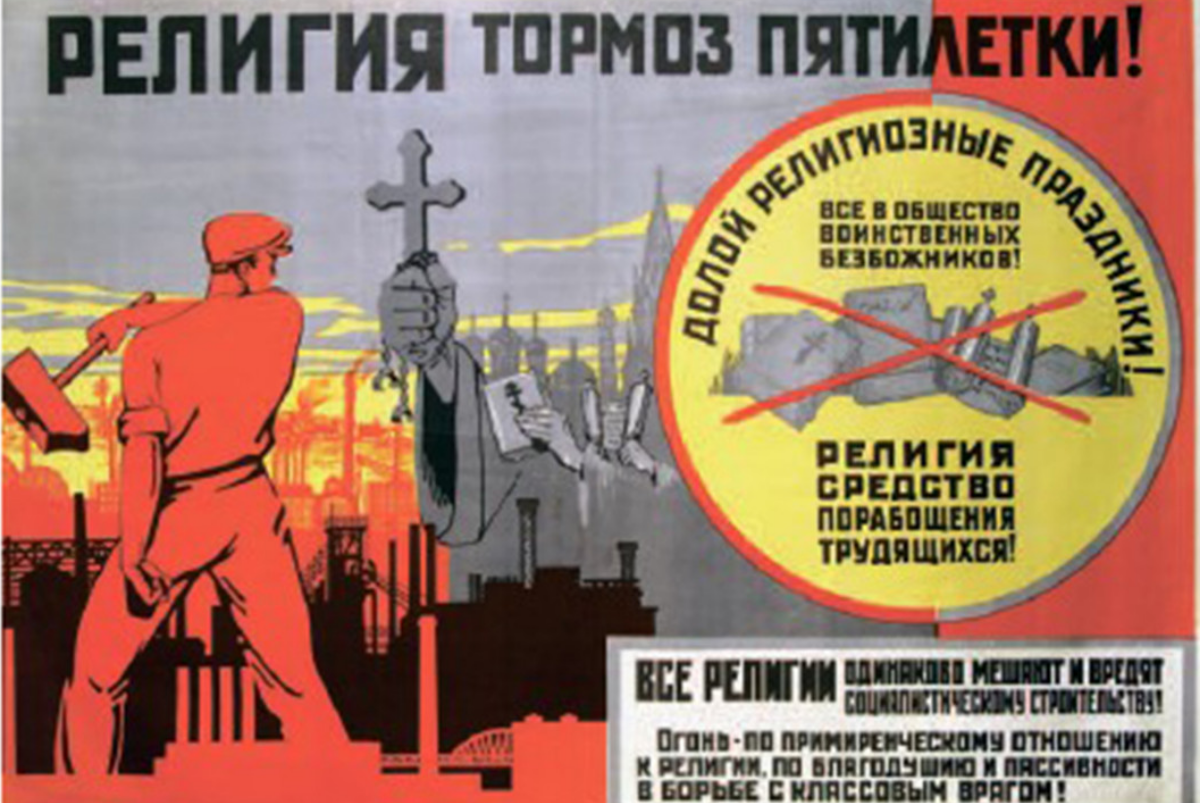
We must not fetishise our colleagues as proletarian mystics; they are alike the Soviet peasants who may well have possessed profound conceptions of God and religion. But when the first radio towers were erected in their villages, they stared in raptest awe; Communism brought them miracles far greater, far realer than their saints.
In the absence of anything else, the way we erect these radio towers in the modern day is to deliver a victory. That first victory–the real proof that there is lurking power that exists in the hands of all the class–is only something communism may truly deliver in practice; communism as the real movement, within the present social order, positioned toward the abolition of the present state of things.
And despite the crude idiocies of the Marxists, I do believe they are capable of rising to this task. And in doing so, they might learn, as we all learn one day, that this great and awful word, “Communist”, is not a mark of a martyred apostle, or a beast of burden to carry our woes.
Instead, they will know “Communist” is a title, earned and kept, and carried with pride.
The Working Class: Religion vs. Reality
Education workers, and the Communist Party as the vanguard in the struggle, should consider it their fundamental task to help enlighten and instruct the working masses, in order to cast off the old ways and habituated routine we have inherited from the old system, the private property habits the masses are thoroughly imbued with.
Lenin, “Left-Wing” Communism: An Infantile Disorder, p. 365
I
There appears two ‘working classes’: the working class as a political subject that is being organised (the class-for-itself), and the idea of ‘the working class’, which is tantamount to a civic theology concocted around the conditions of wage-labour (a fetishisation of the class-in-itself).
II
The strength of the worker-religion is weakened by the real organisation of the political subject. This is because, far from building a real unity, the struggle is about delineating the class and its enemy in a real sense. Coworkers who do not strike become scabs; allies of management become workplace cops.
III
The working class as a political subject can be ‘learned from’, but only as a product of its action in accordance to an organic doctrine.
This presupposes an organisation of the working class for itself, i.e., for its abolition, by which this political subject can exercise its power.
Without the organisation, the worker-religion is all that’s left, and we conclude that wage-labour is solely instructive in the proceedings of consciousness; that it is the method of learning, rather than the grounds upon which it occurs.
Yet, the workers curiously resist history’s attempts to turn them into communists.
IV
The real class unity is not about uniting class-sects; it is about establishing who is for and who is against the class.
For this to happen, there must, again, be a class organisation.
V
If elements of the proletariat oppose their own liberation, they are not simply misled from their real interest; they have accepted the religious class-order over the real one. Whether this comes from an attempt to preserve a fleeting hierarchy, a convoluted false consciousness, or sheer stupidity, does not matter.
VI
The working class as a subject does not resolve its disputes democratically. It resolves its disputes forcefully: separation, segregation, and, when tensions are high enough, elimination. The class-for-itself, wishing to abolish the class-in-itself, is in conflict with those workers who simply identify the class-in-itself as their essential state of being.
In order for the class-for-itself to come into being, a definite labouring mass must have identified the extent of its own potential power. In other words, it must have been made lucid of its real conditions and then acted upon them.
VII
When the class-in-itself becomes the class-for-itself, it has given a definite form to what can now be called ‘the Party’.
VIII
The Party, representing the organisation of a real movement, possesses a doctrine. This doctrine’s determination cannot be a product of any democratic force within the Party, but the real authority behind its operation.
It is a mark of dogmatic institutionalism to suggest that the arrangement of the Party’s organs change the doctrine to which it will always adhere: the abolition of class society. The premises of the abolition of class society do not actually change because of the decisions of a party’s democratic organ.
The Marxist doctrine is not divined, but developed. It lies beyond the imagination of some people that a doctrine’s evidence is in its success, not its determination.
IX
If a clique were to attempt to dethrone the revolutionary objective of world-revolt, self-abolition, et cetera, and it were in the means of the class to reject this clique, the answer is not to concede to a democratic abstraction, but to operate via real power structures to nullify them.
X
In all of this there is a real programme for liberation.
But at every moment in this programme, there will be those who ask about the sanctity of the worker-religion, who demand the whole class be represented, that there is moral sanctity to the root of the proletariat’s oppression–their status as proletarians.
In protection of the class’ angelic virginity, the devout apostles of the worker-religion demand a return to democratic form; they may even suggest that the proposal of a vanguard organisation itself, even with no actual working organisation in question, is a form of manifest harm to this celestial virgin.
This ludicrous superstition must be driven out of the skulls of any class-conscious proletarian; that they ought love their work, that they are purer, greater for their sacrifice at Capital’s altar.
We demand, however, the altar’s desecration; a real overthrow of the ridiculous demand we kill ourselves for the money-god.
Fetishisation of the Instant Form
“All that is solid melts into air, all that is holy is profaned, and man is at last compelled to face with sober senses his real conditions of life, and his relations with his kind.”
Karl Marx, Manifesto of the Communist Party, p. 16
XI
The objective of present-day communists, when it comes to questions of organisation, appears as the identification of latent consciousness. Thus begins the great search for a hidden revolutionary mass that eludes us; so we may conclude the answer is the lumpen, or the racialised masses, or the ever-waged queer rebellion against the family, or the imperialised and colonised periphery, etc.
Some Marxists, working on age-old Eurocentric divinations, even go so far to actually conclude that the first-world masses are, in fact, the most developed revolutionary subject!
We look for a group to whom we may prescribe consciousness, to contort into the shape of the Marxist doctrine. Then, when they do not behave as this perversity has demanded of them–when there is still no real communism in evidence–the enemy can become literally anything but the bourgeoisie.
It is very rare indeed for a Marxist to conclude that consciousness is not a latency of any specific sectional identity, but a world-historic immanence of capitalist production in general; that the real process is supreme over the fetishised form.
XII
This form-fetishism can be retroactively deemed correct if social revolution occurs in such a fashion that it is led by members of the fetishised form. The danger emerges when this form is then transposed beyond immediate struggle; when the present attempts, in increasing desperation, to reach into the past. The form-fetishism is itself fetishised, and the attendant doctrinal modernisations are transformed into a class-religion, which becomes a dogma. When the dogma is proven incapable of meeting new needs, it is ‘revised’, and there is this bargain struck between the dogma and revision, where both are understood as bad, but in relation to one, essential doctrinal truth.
GLOSS: In history, we can see this no clearer than with Mao.
Mao’s concept of New Democracy is based upon ‘camps’ within society that build socialism together. This emerges from a form-fetishisation of a particular character: the “peasant”.
The peasant is understood as inherently non-proletarian; but in China, there was indeed in many cases a C-M-C/surplus value extraction relationship between rural tenants and their landlords. Yet their particular place in the town-country distinction was fetishised as a category unto itself, and thus any corollary interest between the proletarians and ‘the peasantry’ was collapsed into a ‘contradiction’ to be resolved ‘democratically’.
Mao talks a lot about ‘dogma’ and ‘revision’, all in relation to a doctrine based on false premises. Today, Maoists blame the rightist clique for its complete and utter destruction of ‘Chinese socialism’, and lament the orphaned child of a forgotten time.
XIII
Now that the form-fetishised spectre appears as a real force in sect and tendency, some who claim to be on the ‘Communist Left’ will belabour themselves with the vanquishing of this spectre. They demand progress toward a ‘class unity’ in the face of racial, gendered, and national hierarchies. Notably, this demand does not really abolish the reality of these stratifications.
One can only wonder how this led to a severe overpopulation of blisteringly white left-communists.
XIV
The real class-unity is not within the class-in-itself, but the class-for-itself; the Party is a product of a real unity in the latter, rather than a force instrumentalised for the unity of the former.
To simplify: if a class-organisation appears as a movement of racialised workers, the task is not to demand an allegiance to ‘white workers’, but instead to view class struggle as an abolition of racism; to view Capital as the enemy, not white Capital.
XV
So: the Marxist doctrine does not inform people how to halt their struggle, but rather how to continue and elevate it; to bring it to its logical conclusion, to smash Capital and all who stands in its way. If the sectionally-supreme workers, in that instance, decide they will stand in Communism’s way, the Marxist doctrine, which cares little for whiteness, manhood, cisheterosexuality, or anything else, happily allows their political subjugation.
XVI
Vulgar ‘class-first’ politics thereby appears not as a negation of sectional identitarianism, but the fortification of the dominant sectional positions.
Still belaboured by an obsession with majoritarian consensus, with ‘democracy’ (or whatever else they may call it), these vulgarisers believe that the class-for-itself must seek assent from its immediate enemies, in order to appease the Godly beliefs of the worker-religion.
Through their attempt to return to base order, they have only found themselves in the base order of civil society: affirming dominant race, gender, and national norms.
XVII
A true class-politics, divorced from all pretensions, is one that is unconcerned with the practical assent of anyone other than they who are necessary for social revolution. This understanding is what allows a real liberation to take form.
GLOSS: This understanding appears callous, it appears cruel; it is the understanding capital gives us nonetheless. One might ask: the promises of the communist revolution are great indeed, but how can you help me, in the here and now?
The answer is: as we always have. By sheltering those in need, and having those to shelter us; by building support structures that can stand the test of weary souls.
Marxism, however, is not the doctrine of living under capital. Marxism is the doctrine of abolishing it. Through this narrow understanding, we liberate ourselves from needing to contort it into an intimate politicisation, to explain the minutiae of individual selves via its lens, to treat our transient organs as a real movement.
You’re allowed to help your friends and peers, and you don’t need sanction from Saint Marx.
XVIII
This understanding is what allows us to properly contextualise and elaborate on movements of the oppressed, directed for their liberation, rather than click our tongues and demand they stop.
GLOSS: Take Palestinians, who we will take in evidence the interest that they see an end to Israeli oppression.
Those who identify imperialism as the primary contradiction will say: the tactics of Hamas are the primary weapon in our fight.
Class-first vulgarisers will say: neither Israel nor Palestine! And try and delude themselves with the ridiculous proposition that “Palestine is imperialist.” There are real people who say this and demand you take them seriously.
The Marxist position is simply to accept that the Palestinians struggle as they do because they have to, and that we cannot tell them to stop struggling in the certain way foisted upon them, that we can only elaborate upon that struggle, to say: a Free Palestine is an excellent goal, but why simply stop there?
And in fact, we should organise our own ‘national workers’ to advance themselves, and in revolutionary strike action disrupt the supply chains of Empire. This would also, presumably, help the Palestinians.
Should such a development arise, we could then see in the mutual struggle, no matter how divorced by distance or subsistence condition, the emergence of a common interest; something capable of developing into a united political subject.
But this would only be a product of that organisation, of that immediacy; we cannot prescribe it beforehand.
In other words, the united emergence of the Party is not an essential product of the present historical instance, but the real outcome of invariant historical forces. Doctrinal ‘modernisation’ is the assumption that the Party is anything but.
XIX
Communism remains an immanence to the invariant properties of capital. The question is not how instances wrap themselves around these invariants, but to understand how these instances are the product of invariants.
Unions and Class-Consciousness
“The history of all countries shows that the working class, exclusively by its own effort, is able to develop only trade union consciousness, i.e., the conviction that it is necessary to combine in unions, fight the employers, and strive to compel the government to pass necessary labour legislation, etc.”
V.I. Lenin, What Is To Be Done?, p. 17-18
XX
It is understood that trade union organisation only produces trade union consciousness.
GLOSS: The remnants of the old trade union bureaucracy remain some of the most infernal vestiges of British left-TERFism. Bereft of any politics left to actually do, and feeling constantly undermined, the only shit they’ve got left is to obsess about the gamete (something they very clearly do not understand). “Gender critical” thought becomes another religion, the sigh of this oppressed, gelatinous creature we find at the heart of reformist politics.
XXI
Not all unions are the same. Workplaces that are in the embryonic process of unionising–and are thus less concerned with the construction of an elaborate union bureaucracy–are not as ossified as a developed union.
XXII
Given the tendency of unionisation to self-nullify, to assemble structures that strangle even the most dedicated root organisers, to seek collaboration and ‘peace’ with the bourgeoisie, it is clear that at some point the negative force of class struggle results in the creation of a positive politics.
XXIII
The proletariat’s world-historical position is not a position at all, but the negation of the position of class society; thus follows the negation of the negation, the fact that the ‘proletariat’ itself is simply an infliction of the class society it is immanent to, and historically strives to abolish.
Socialist experiments in history can have their failures explained by their points of defeat whereby they were compelled to establish positions for a class society: the failure of international revolution, the creation of a ‘socialist civilisation’ in its stead.
Trade unions, likewise, lend themselves to a positive order.
XXIV
When class organisation extends beyond a certain scale, it must be maintained.
The Party finds its definition in what occurs when a supreme class organ arises for its maintenance, with a negative, abolitionist programme of overthrowing the old society. Trade unions are the emergence of a class struggle that understands itself in isolation.
The real union is the bureaucracy that emerges as “the first line of defense of the working class”, the means by which the encroachments of capital are fought against through organisation and strike action. In the absence of a negative, world-historical doctrine, however, this can only lead to the production of a union position; union bureaucrats, union identity, union consciousness.
Introducing a new doctrine would upend this position and as such it is much harder to introduce Marxism to an established union bureaucracy.
XXV
It is the Marxist objective to translate consciousness into a negative class organ before the imposition of a positive politics.
For this to be in evidence to workers, Marxists must provide, in evidence, proof of the doctrine’s success and utility to them.
XXVI
The only way for the utility of Marxism to independently arrive in evidence is for its doctrinal intervention at a moment of crisis to elaborate existing struggle.
In other words, the doctrine must [a] be correctly developed, and [b] be ready for application via existing, communist class organs, constituted not as the first line of defense, but as the first line of offense.
XXVII
To those who say a diagnosis of spontaneity to revolution serves to intellectually postpone it indefinitely: don’t worry, the crisis is arriving soon.
Some say it is already here.